

Serve and Return

I follow Zero to Three, an organization dedicated to the care and management of children from birth to age three as indicated by the name of the organization. They have several slogans that I find very intriguing from a vision standpoint even though they do not acknowledge vision directly. A post or concept is always followed by one of those “Bubba Adds” comments.
I have used their comment that states, “School readiness begins at birth.” I love that statement but will add, “If school readiness begins at birth, then life readiness begins at birth.” Also vision should emerge as the driver of school and life readiness. It is not simply a matter of “seeing.” It is a matter of developing the ability to look toward and engage in interests and curiosities. If the child does not develop such abilities, all aspects of readiness will be limited. You cannot wait to determine what something is until you feel it. You must use vision to manage the situation well before being able to touch. Whether a curiosity, interest, or threat, it must be identified prior to engagement and this comes when vision becomes the driver of actions toward engagement. A touch initiates a visual action toward the touch for identification and a decision of whether to engage or not.
Their most recent concept is wonderful – Serve and Return. Other organizations have been discussing this for a while but the actual term came before me last week from a Zero to Three Facebook post. Serve and Return is not unique to Zero to Three but their graphic was an excellent demonstration of the link between the external world and the child interests and curiosities come through vision.
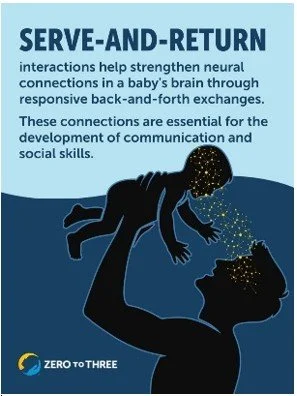
Facebook Post from Zero to Three
Serve and Return works both ways - the baby serves and the caregiver returns or the caregiver serves and the baby returns. In most of the discussion(s), vision was given little consideration in the description although the graphics and illustrations showed a direct link. Notice the indirect references to vision in the following excerpt from the Facebook post:
“One of the best ways to support healthy brain development is through serve-and-return interactions: the back-and-forth of talking, playing, making faces, and responding to your baby's sounds and cues. These everyday moments help build the brain, one interaction at a time.”
Harvard University has a pdf entitled 5 Steps for Brain Building – Serve and Return. Again though not directly mentioned, vision is a significant part of the Serve and Return interactions.
The Five Steps*
- Notice the serve: Pay attention to what the child looks at, points to, or coos at.
- Return the serve: Show you care with a smile, a nod, or your own words.
- Name it: Say the name of the object or feeling the child is looking at.
- Take turns: Keep the back-and-forth going and wait for their reply.
- Endings and beginnings: Let the child decide when to move to a new game.
*Harvard University Center on the Developing Child
Bubba Adds Notice how many times in this brief recommendations that “looks at,” “points to,” “coos at,” and respond, “with a smile, a nod,” etc., all which involve vision through looking. Vision must emerge as the driver of actions toward engagements in curiosities and interests. A child’s random movements at birth do not just happen to evolve into precise reaches and engagements. A light, sound, touch, aroma, or even taste initiates a desire to look toward the stimulus and then develop movements sufficient to get to the object which has become a curiosity or to react to a facial expression from a caregiver.
Consider how this plays out through all curiosities, interests, and interactions. Obviously if a child is blind or severely visually impaired, these interactions may take a different path and role. But I am talking about the child who is expected to develop in a typical manner.
Gaze Following and Language Development Andrew Meltzoff and colleagues from the University of Washington has done a significant amount of work regarding the interaction between baby and caregiver which is called gaze following. In a sample of babies first tested at age 12 months, their ability to follow a parents gaze was related to ability to understand words at 18 months. When the child consistently followed a parents gaze + simultaneous vocalization to an object at 12 months, they understood more words at 18 months than babies who did not follow the parent’s gaze (337 vs 194).
They specifically state, “Whereas 9-month-olds may view others as ‘body orienters’,older infants begin to regard others as ‘visually connected’ to the external world, which is a potentially important step in social cognition.” The development of gaze following and its relation to language, Rechele Brooks and Andrew N. Meltzoff - Institute for Learning and Brain Sciences, University of Washington, USA Dev Sci, November 2005 8(6): 535-543
Bubba Adds Now consider the course of development if vision does not become the driver. The missed reactions to curiosities. The lack of developing efficient actions and movements. Limited communication. Limited intentional actions toward engagement. Serve and Return interaction from an early age is an excellent concept but actions directed through vision must be encouraged as the primary action toward engagement(s). When the visual engagement is delayed, all of these process will be limited as well as full integration and use.
In typical development, vision becomes engaged immediately at the point of the stimulus to find the origin of the light, sound, touch, aroma, or taste. Curiosities expand and movements are developed to engage in these curiosities. Vision must emerge as the instigator and the influencer of these actions toward engagement which opens the door to the many possibilities of life and learning.
Serve and Return in Testing We should consider the serve and return concept as a major part of testing whether an infant or adult. My primary tool is observing engagement through Just Look Retinoscopy. Probes with an infant beginning with a challenging target and then change to another target is one example. How do they return serve? For an older child, finding letters on a target with some letters missing and observe the change as they look for the missing letter. Also, using a +/-2.00 on a target to observe HOW the patient responds as the lenses are changed. These are examples of serve and return – a target that changes or that is changed requires one to look differently.
Our task is to go beyond any singular piece of testing and challenge the patient to determine HOW they respond and if it is appropriate for the cultural demands and expectations. Observations as you Serve and Return will show patterns of engagement that will be used throughout life if sufficient for cultural expectations. If insufficient for cultural expectations, the child chooses a stage of withdrawal until the activity becomes easier which does not allow full engagement. Lenses and/or vision therapy may provide the intervention necessary to redirect actions toward engagement.